- Home
- Electronics
- Best Dash Cams 2026: Viofo A22 ...


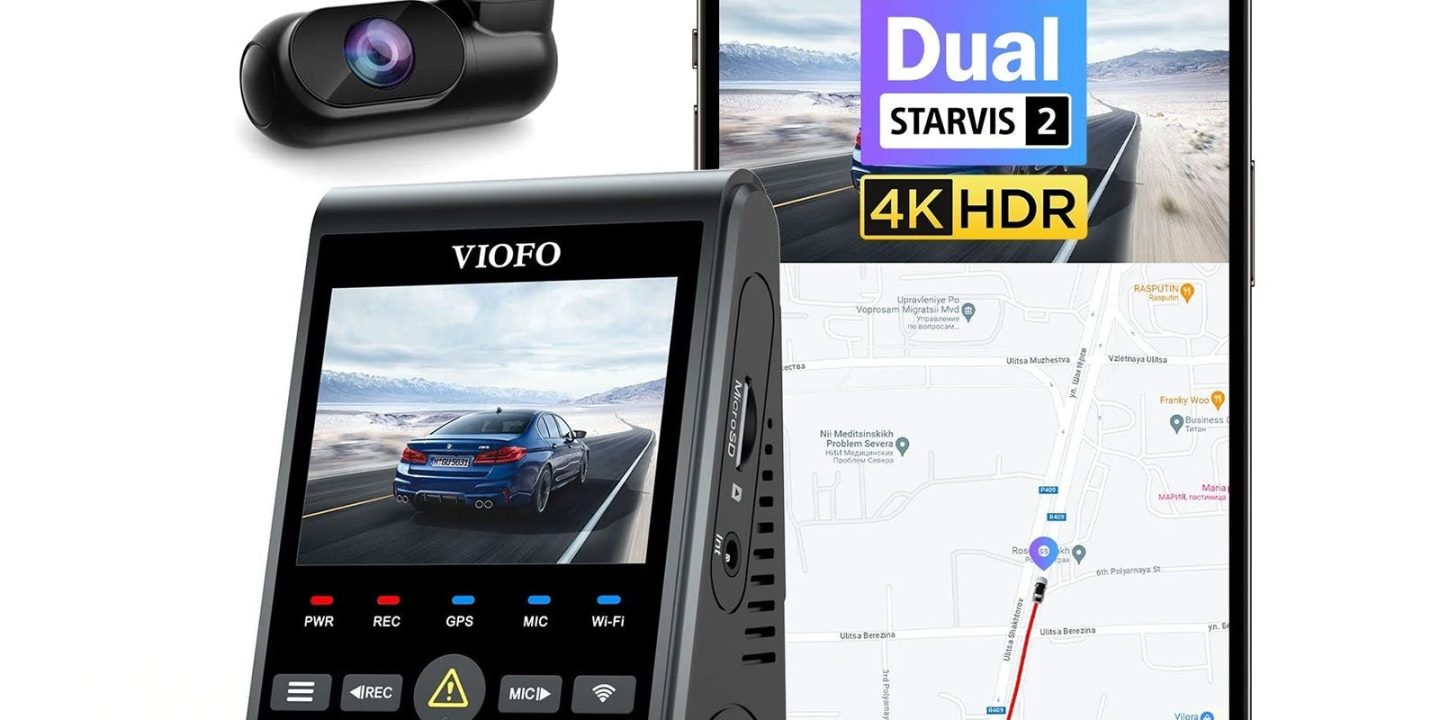
A good dash cam is the cheapest insurance you will ever buy for your car. It records what happened, not what anyone remembers happening, and the best models in 2026 do it in sharp 4K, day and night, with parking mode that watches the car while you are away. This guide compares the best dash cams of 2026, based on published specs from the manufacturers, so you can see exactly what your money buys before you stick anything to your windscreen.
Prices below are typical US list or retailer prices. Prices move constantly, so treat the figures as a snapshot — last checked: 19 Nov 2026.
Contents
- Best dash cams at a glance
- Viofo A229 Pro 2CH — best overall
- Garmin Dash Cam Mini 3 — best discreet
- Nextbase 622GW — best for features
- Vantrue N4 Pro — best for rideshare
- Nextbase Piqo 2K — best budget
- What to check before you buy
- Watch: the best dash cams of 2026
- Final verdict
- Frequently asked questions
Best dash cams at a glance
| Dash cam | Channels | Front resolution | Screen | Price* |
|---|---|---|---|---|
| Viofo A229 Pro 2CH | Front + rear | 4K | Yes | $279.99 |
| Garmin Dash Cam Mini 3 | Front only | 1080p | No | $129.99 |
| Nextbase 622GW | Front (+ rear optional) | 4K | Yes, 3-inch touch | Around $299 |
| Vantrue N4 Pro | Front + cabin + rear | 4K | Yes | $259.99 |
| Nextbase Piqo 2K | Front only | 2K | No | $134.99 |
*Prices are typical US list or retailer prices, last checked: 19 Nov 2026. Sale prices are often lower, and rear-camera bundles cost more.
Viofo A229 Pro 2CH — best dash cam overall

The Viofo A229 Pro 2CH is the dash cam to beat in 2026, and the reason is the sensors. The front camera records genuine 4K through a Sony STARVIS 2 IMX678 sensor, and the rear camera records a real 2K through a second STARVIS 2 sensor, the IMX675 — the first dash cam to use two flagship STARVIS 2 sensors, according to Viofo. That matters at night and in rain, when cheaper cameras smear number plates into unreadable blobs. It also has voice control, GPS, Wi-Fi for phone playback, and a supercapacitor instead of a battery, which handles hot windscreens far better than lithium cells.
There are two costs to budget beyond the $279.99 price. No memory card ships in the box, so add a high-endurance card (up to 512GB is supported), and parking mode needs Viofo’s HK4 hardwire kit, bought separately. A three-channel version with a cabin camera is also available if you drive for a rideshare service. If you want the clearest front-and-rear footage you can buy without spending flagship money, this is the pick.
What we love: dual Sony STARVIS 2 sensors, true 4K front and 2K rear, voice control, GPS and Wi-Fi, supercapacitor for heat. Considerations: no memory card in the box, parking mode needs a separate hardwire kit, $279.99 is not a budget buy.
Garmin Dash Cam Mini 3 — best discreet dash cam
The Garmin Dash Cam Mini 3 is barely bigger than a car key, and once it is tucked behind the rear-view mirror you will forget it is there — which is exactly the point. It records 1080p video through a 140-degree lens, has voice control (“OK Garmin, save video”), a built-in clarity polariser to cut windscreen glare, and a supercapacitor rather than a battery. At $129.99 it is the cheapest way into a reliable, well-supported dash cam from a major brand.
The trade-offs are honest ones. There is no screen, no rear camera, and no memory card in the box. It also has no GPS of its own: speed and location stamps appear only if it syncs with a GPS-equipped Garmin camera. If you want a camera that simply records the road ahead, in good quality, without fuss or a visible box on your windscreen, the Mini 3 is hard to beat.
What we love: tiny and discreet, 1080p with a polariser, voice control, supercapacitor, $129.99. Considerations: front only, no screen, no GPS of its own, no card in the box.
Nextbase 622GW — best dash cam for features
The Nextbase 622GW is the feature-packed option: 4K recording at 30 frames per second (or 1080p at 120 frames per second for smoother motion), a 3-inch touchscreen, GPS, Alexa built in, what3words location sharing, and Emergency SOS, which can alert emergency services after a serious impact. It is the most “smart” dash cam in this guide, and the touchscreen makes it the easiest to set up and review footage on without reaching for your phone.
At around $299 for the front camera alone it is a premium buy, and a rear camera module costs extra, pushing a full front-and-rear setup well past $350. The image quality is strong in daylight, though the Viofo’s STARVIS 2 sensors have the edge after dark. Buy the 622GW if you want the most complete feature set and the easiest on-camera experience; buy the Viofo if night-time plate readability is your top priority.
What we love: 4K with a 3-inch touchscreen, Alexa and what3words, Emergency SOS, GPS included. Considerations: around $299 before adding a rear camera, night footage trails the Viofo, larger than the Garmin.
Vantrue N4 Pro — best dash cam for rideshare drivers
The Vantrue N4 Pro is built for drivers who need to see in three directions at once: a 4K front camera, a 1080p cabin camera with infrared for night-time passenger recording, and a 1080p rear camera, all in one box. Like the Viofo it uses Sony STARVIS 2 sensors and a supercapacitor, so it handles heat and low light well. At $259.99 it undercuts the Viofo three-channel setup while covering the cabin, which is why it is the natural pick for Uber and Lyft drivers, and for anyone who regularly carries passengers.
The cabin camera is the point of this camera, so if you never carry passengers it is wasted money — the two-channel Viofo records sharper rear footage for a similar price. Parking mode, as with most dash cams, needs a hardwire kit. But for rideshare work, three channels for $259.99 is a strong deal.
What we love: three channels including an infrared cabin camera, 4K front with STARVIS 2, supercapacitor, $259.99. Considerations: rear footage is 1080p, not 2K, cabin camera is wasted if you drive solo, parking mode needs a hardwire kit.
Nextbase Piqo 2K — best budget dash cam
The Nextbase Piqo 2K is the cheapest proper dash cam in this guide at $134.99, and it is a smarter buy than the no-name 4K cameras that flood online marketplaces. You get 2K front recording, a compact body with no screen, app-based setup and clip sharing, and Nextbase’s warranty and support behind it. For a second car, a teenager’s first car, or anyone who wants a dash cam without spending $250 or more, it covers the essentials well.
What you give up is resolution and expandability: 2K is good, but it will not read a plate at the distance a 4K camera can, and there is no rear-camera option. There is also no screen, so all setup and playback goes through the app. If your budget is firm at around $130, the Piqo is the safe choice; if you can stretch to $279.99, the Viofo is a big step up in evidence quality.
What we love: $134.99, 2K recording, compact and simple, trusted brand and support. Considerations: no rear-camera option, no screen, 2K will not read plates as far away as 4K.
What to check before you buy
First, decide how many channels you need: front-only is enough for most drivers, front-and-rear is the sensible default, and a cabin camera only matters for rideshare or passenger work. Second, look at the sensor, not just the resolution — a 4K camera with a good Sony STARVIS 2 sensor beats a cheap “4K” camera with an unnamed sensor, especially at night. Third, budget for the extras: a high-endurance microSD card (standard cards wear out fast under constant rewriting) and, if you want parking mode, a hardwire kit and a professional install. Fourth, check the power source: supercapacitors survive hot summers far better than lithium batteries. Finally, remember that a dash cam is only useful if the footage is readable — 4K front recording is worth the premium if you drive at motorway speeds or in heavy traffic.
If you are securing the rest of the house as well, our guide to the best home security cameras without a subscription covers indoor and outdoor cameras, and our best 360 cameras roundup covers action cameras for recording your trips. Manufacturer pages: Viofo A229 Pro, Garmin Dash Cam Mini 3 and Nextbase 622GW.
Watch: the best dash cams of 2026
For a visual comparison of the Viofo, Vantrue and Garmin models in this guide, including how each handles number plates day and night, watch this video:
Final verdict
For most drivers, the Viofo A229 Pro 2CH at $279.99 is the best dash cam of 2026: dual STARVIS 2 sensors, true 4K front and 2K rear footage, and the night-time clarity that turns footage into evidence. If you want the camera to disappear, the Garmin Dash Cam Mini 3 at $129.99 is the discreet pick. Rideshare drivers should buy the Vantrue N4 Pro for its cabin camera, and anyone on a tight budget should start with the Nextbase Piqo 2K. Whatever you choose, add a high-endurance memory card and check your local rules on dash cam use before you fit it.
Frequently asked questions
Do I need a front-and-rear dash cam, or is front-only enough?
Front-only is enough for most drivers, since the majority of incidents happen ahead of you. Front-and-rear is worth it if you park in busy areas, drive in heavy traffic, or want evidence for rear-end collisions, which are among the most common claims.
Does a dash cam need a subscription?
No. Every camera in this guide records to a memory card with no subscription. Some brands offer optional cloud plans for remote viewing or alerts, but basic recording and parking mode (with a hardwire kit) work without paying monthly.
What is parking mode, and do I need a hardwire kit?
Parking mode records bumps or motion while the car is parked. It needs constant power, which means a hardwire kit wired to the fuse box — the camera’s supercapacitor only bridges a few seconds so the last clip saves cleanly. Without a hardwire kit, the camera stops when the ignition is off.
How big a memory card do I need?
A 128GB high-endurance card is the practical minimum, and the Viofo supports cards up to 512GB. Buy a card rated “high endurance” or “max endurance”: standard cards wear out quickly under the constant rewriting a dash cam does, and a failed card means no footage when you need it.
Is 4K worth it over 1080p in a dash cam?
Yes, if you drive at motorway speeds or want to read number plates at a distance. 4K captures roughly four times the detail of 1080p, which is often the difference between a readable plate and a blur. For slow city driving, a good 1080p camera like the Garmin Mini 3 is still useful evidence.