- Home
- Electronics
- Best Portable Power Stations 2 ...


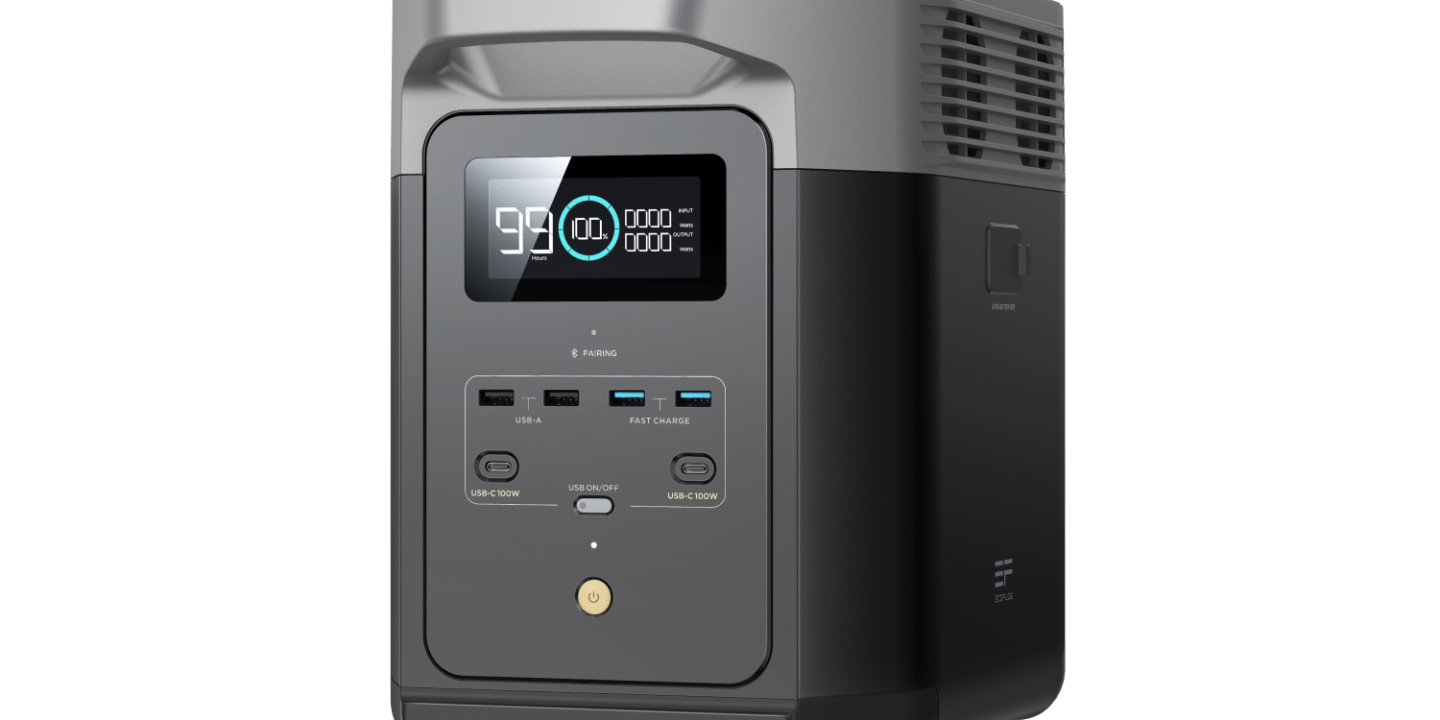
A power cut used to mean candles and a dead phone. In 2026 it means reaching for a portable power station: a lunchbox-sized battery with wall sockets, USB ports and a display showing how long your fridge, laptop and router will keep running. The same box goes camping, powers tools, and keeps a home office alive. The technology has settled too — lithium iron phosphate (LiFePO4) batteries are now standard, lasting 3,000 to 4,000 cycles instead of the 500 or so of older lithium cells.
In this guide we compare the four best portable power stations of 2026 in the popular 1,000Wh class: the EcoFlow DELTA 2, the Jackery Explorer 1000 v2, the BLUETTI AC180 and the Anker SOLIX C1000. We compare them on published specs and current pricing from the manufacturers’ stores. We have not tested these stations hands-on. Prices were last checked on 18 Nov 2026 and vary by retailer, often by hundreds of dollars during sales. One rule of thumb: a station rated at 1,000Wh delivers roughly 850–900Wh of usable power.
Contents
- Our Quick Picks
- Portable Power Stations Compared
- EcoFlow DELTA 2
- Jackery Explorer 1000 v2
- BLUETTI AC180
- Anker SOLIX C1000
- How to Choose a Portable Power Station
- Watch: EcoFlow DELTA 2 vs Jackery 1000
- Final Verdict
- Frequently Asked Questions
Our Quick Picks
- Best overall: EcoFlow DELTA 2 — 1,024Wh, 1,800W output, the fastest recharge in the class and the most complete app — $999 list, often $599–$799 on sale.
- Best for first-time buyers: Jackery Explorer 1000 v2 — 1,024Wh, 1,500W output, the simplest interface and the lightest build, at $559.
- Best for tools and job sites: BLUETTI AC180 — 1,152Wh, 1,800W output with a Power Lifting mode, typically $499–$699 on sale.
- Best value right now: Anker SOLIX C1000 — 1,056Wh, 1,800W output, expandable to 2,112Wh — $599.99 list, around $469.99 on sale.
Portable Power Stations Compared
| Feature | EcoFlow DELTA 2 | Jackery Explorer 1000 v2 | BLUETTI AC180 | Anker SOLIX C1000 |
|---|---|---|---|---|
| Price | $999 list; often $599–$799 | $559 | Typically $499–$699 | $599.99 list; often ~$469.99 |
| Capacity | 1,024Wh | 1,024Wh | 1,152Wh | 1,056Wh |
| AC output | 1,800W (2,700W surge) | 1,500W (3,000W surge) | 1,800W (2,700W surge) | 1,800W (2,400W surge) |
| Battery | LiFePO4, 3,000 cycles | LiFePO4, 4,000 cycles | LiFePO4, 3,500 cycles | LiFePO4, 3,000 cycles |
| AC recharge | 0–80% in ~50 min (X-Stream) | 0–100% in ~50–60 min | 0–100% in ~1 hour (1,440W input) | 0–100% in 58 min (HyperFlash) |
| Solar input | Up to 500W | Up to 400W | Up to 500W | Up to 600W |
Last checked: 18 Nov 2026. Prices vary by retailer and change frequently during sales; check the manufacturer’s store before buying.
EcoFlow DELTA 2

The EcoFlow DELTA 2 is the station every other one is compared against, and it earns that position. It packs 1,024Wh of LiFePO4 battery into a 27-pound box with a 1,800W continuous inverter (2,700W surge) — enough to run a full-size fridge through an outage. The headline feature is recharge speed: EcoFlow’s X-Stream charging takes the unit from empty to 80% in about 50 minutes from a wall outlet, and it accepts up to 500W of solar input.
The DELTA 2 is also the most expandable station here, growing to 3,072Wh with extra batteries, and its app is the most complete — live power data, charge controls and remote port management over Wi-Fi or Bluetooth. The battery is rated for 3,000 cycles to 80% capacity, and the warranty is 5 years. The list price is $999, but it is frequently discounted to $599–$799, and at sale prices it is the best all-round station you can buy. The only real weaknesses are weight — 27 pounds is a two-hand carry — and a higher idle power draw than the Jackery.
What We Love
- Fastest recharge: 0–80% in about 50 minutes
- 1,800W output handles fridges and power tools
- Expandable to 3,072Wh
- Best app, with live power data
Considerations
- List price of $999 — only good value when on sale
- 27 pounds and a higher idle draw than the Jackery
- 3,000 cycles is fewer than the Jackery’s 4,000
See the EcoFlow DELTA 2 product page for current pricing and full specifications.
Jackery Explorer 1000 v2
Jackery created this category, and the Explorer 1000 v2 is its friendliest station. The v2 refresh moved the whole line to LiFePO4 chemistry, so the battery now lasts 4,000 charge cycles — the longest here — with a 10-year design life. It delivers 1,024Wh of capacity with a 1,500W continuous output (3,000W surge), charges from empty to full in about an hour with Emergency Super Charge, and weighs 23.8 pounds, making it the lightest station here.
At $559 on jackery.com it is also the cheapest station here at list price, although Jackery notes it is currently sold out due to high demand and points buyers to the newer HomePower 1000 Plus v2 — check stock first. The interface is deliberately simple: a clear display, a handle, no app complexity. The trade-offs are a lower continuous output than its rivals (1,500W against their 1,800W), no expansion battery option, and 400W of solar input against the Anker’s 600W.
What We Love
- 4,000 charge cycles — the longest here
- Lightest in the class
- Simplest interface; no app required
- $559 — the cheapest here
Considerations
- 1,500W output is lower than the 1,800W rivals
- No expansion battery option
- Currently sold out on jackery.com — check stock and alternatives
See the Jackery Explorer 1000 v2 product page for current pricing and availability.
BLUETTI AC180
The BLUETTI AC180 is the workhorse of the group. It has the biggest battery here at 1,152Wh of LiFePO4, a 1,800W continuous inverter with a 2,700W surge, and a rugged build that suits van life, job sites and tailgating. Its Power Lifting mode lets it run some resistive loads above its continuous rating for short periods — useful for kettles and heaters — and it accepts up to 1,440W of AC input, so it recharges from a wall outlet in about an hour.
At typically $499–$699 depending on sales, the AC180 often undercuts the EcoFlow DELTA 2 while matching its output — the best portable power station per dollar in this class. It also works well as a UPS for a desktop PC. The downsides are weight — 35.3 pounds makes it the heaviest station here — and a less polished app than EcoFlow’s. If your station mostly stays in one place and powers heavy loads, the AC180 is the one to buy.
What We Love
- Biggest battery here: 1,152Wh
- 1,800W output with Power Lifting mode
- Recharges in about an hour
- Best output per dollar
Considerations
- Heaviest in the class at 35.3 pounds
- App is less polished than EcoFlow’s
- No expansion battery option
See the BLUETTI AC180 product page for current pricing and full specifications.
Anker SOLIX C1000
The Anker SOLIX C1000 is the value surprise of 2026. It offers 1,056Wh of LiFePO4 battery, 1,800W of pure sine wave output (2,400W surge), and Anker’s HyperFlash charging — 0 to 100% in 58 minutes — for $599.99 list, with street prices around $469.99. That makes it the cheapest 1,800W station in this guide at street price, and it is also expandable: an extra battery takes it to 2,112Wh.
The C1000 accepts up to 600W of solar input, the highest here, and works as a UPS with a 10 ms switchover for a desktop PC. It weighs 28.4 pounds, carries a 5-year warranty, and its battery is rated for 3,000 cycles to 80% capacity. Anker has since released a C1000 Gen 2 with 2,000W output and a 49-minute recharge, but it gives up 32Wh of capacity, one AC outlet and the expansion battery — so the original C1000 remains the better buy for most people. If budget is the deciding factor and you still want 1,800W of output, this is the best portable power station for the money.
What We Love
- Cheapest 1,800W station at street price
- Expandable to 2,112Wh
- 58-minute recharge, 600W solar input
- 10 ms UPS switchover
Considerations
- Anker’s lineup is confusing — the Gen 2 model differs in capacity and expansion
- 3,000 cycles is fewer than the Jackery’s 4,000
- App and display are functional rather than outstanding
See the Anker SOLIX C1000 product page for current pricing and full specifications.
How to Choose a Portable Power Station
Start by adding up your loads. A laptop charger draws about 60W, a monitor 30W, a router and modem 20W, a desk lamp 10W — a 120W home-office setup runs for roughly seven hours on a 1,000Wh station. A full-size fridge draws 100–200W while running but needs a much bigger surge to start its compressor. Check the surge rating, not just the continuous output, for anything with a motor.
Then look at chemistry. In 2026 every station in this class should use LiFePO4 — it lasts 3,000 to 4,000 cycles and handles heat better than older NMC lithium. If a station still uses NMC cells, skip it. Next, think about recharge speed: all four stations here recharge in about an hour from the wall. Solar input matters if you camp or live off-grid — the Anker’s 600W is the best here. Finally, weigh it: the BLUETTI at 35.3 pounds stays in the garage, the Jackery at 23.8 pounds goes in the car. Pair it with a home energy monitor to find out what your house actually uses, and a GaN charging station for the devices you charge every day.
Watch: EcoFlow DELTA 2 vs Jackery 1000
A side-by-side test of the two stations that defined this class:
Final Verdict
The best portable power station in 2026 depends on what you value. The EcoFlow DELTA 2 is the best all-round pick: 1,024Wh, 1,800W output, the fastest recharge and the best app — hard to beat at its frequent sale prices of $599–$799. The Jackery Explorer 1000 v2 is the best first station — the simplest to use, the lightest to carry and the longest-lasting battery at 4,000 cycles — if you can find one in stock. The BLUETTI AC180 is best for heavy loads and job sites, with the biggest battery and the best output per dollar. And the Anker SOLIX C1000 is the best value right now, with 1,800W and expansion to 2,112Wh for around $469.99. Whichever you buy, choose LiFePO4, size up by 20% over your need, and buy during a sale — paying list price is a choice, not a necessity.
Frequently Asked Questions
What size portable power station do I need?
Add up the watts of everything you want to run, then multiply by the hours you need it. A 120W home-office setup (laptop, monitor, router, lamp) needs about 120Wh per hour, so a 1,000Wh station runs it for roughly seven hours after inverter losses. A fridge needs 100–200W while running plus a large starting surge. For most households, a 1,000Wh station with 1,800W of output is the sweet spot.
How long do portable power stations last?
Modern LiFePO4 stations are rated for 3,000 to 4,000 full charge cycles before dropping to 80% capacity — about 10 years of regular use. The Jackery Explorer 1000 v2 leads this guide at 4,000 cycles, the EcoFlow DELTA 2 and Anker SOLIX C1000 are rated for 3,000 cycles, and the BLUETTI AC180 for 3,500 cycles.
Can a portable power station run a fridge?
Yes, if it has enough output. A full-size fridge draws 100–200W while running but needs a surge of 1,000W or more to start its compressor. The EcoFlow DELTA 2, BLUETTI AC180 and Anker SOLIX C1000 all offer 1,800W continuous with 2,400–2,700W surge, which covers most fridges. A 1,000Wh station will run a modern efficient fridge for roughly 8–12 hours.
How long does it take to recharge a portable power station?
About an hour from a wall outlet for all four: the EcoFlow DELTA 2 reaches 80% in about 50 minutes, the Jackery Explorer 1000 v2 reaches 100% in about an hour, the BLUETTI AC180 recharges in about an hour, and the Anker SOLIX C1000 reaches 100% in 58 minutes. Solar recharging is much slower and depends on panel size and sunlight.