- Home
- Electronics
- Best Home Theatre Projectors 2 ...


A television tops out at 98 inches if you have a fortune to spend. A projector gives you 120 inches of cinema for a fraction of that, and in a dark room the picture can be every bit as good. The trick is buying the right kind: a cheap projector in a bright room looks washed out, while a proper home theatre projector in a dark room looks like the cinema.
Prices below are US store prices. Prices move constantly, so treat the figures as a snapshot — last checked: 19 Nov 2026.
Contents
- Best home theatre projectors at a glance
- Epson LS11000 — best laser projector overall
- Epson 5050UB — best for a dedicated dark room
- BenQ W4100i — best 4K value
- BenQ W2720i — best all-rounder
- XGIMI Horizon Ultra — best all-in-one
- What to check before you buy
- Watch: is the Epson LS11000 still worth it in 2026?
- Final verdict
- Frequently asked questions
Best home theatre projectors at a glance
| Projector | Resolution | Light source | Brightness | Price* |
|---|---|---|---|---|
| Epson LS11000 | 4K PRO-UHD | Laser | 2,500 lumens | $4,499.99 |
| Epson 5050UB | 4K PRO-UHD | Lamp | 2,600 lumens | $3,799.99 |
| BenQ W4100i | Native 4K DLP | 4LED | 3,200 lumens | $2,499 |
| BenQ W2720i | Native 4K DLP | 4LED | 2,500 lumens | $1,799 |
| XGIMI Horizon Ultra | 4K DLP | LED + laser | 2,300 ISO lumens | $999 |
*Prices are US store prices, last checked: 19 Nov 2026. Brightness figures are manufacturer ratings and are not comparable across brands.
Epson LS11000 — best home theatre projector overall
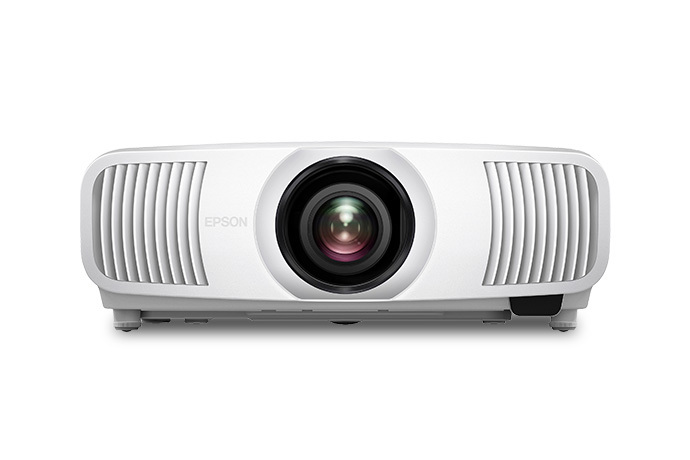
The Epson Home Cinema LS11000 is the best home theatre projector for most dedicated rooms in 2026, even though it has been on sale for about four years. It uses a 3-chip 3LCD laser engine rated at 2,500 lumens of colour and white brightness, with Epson’s 4K PRO-UHD pixel-shifting technology producing 8.29 million on-screen pixels. It supports HDR10, HDR10+ and HLG, has powered zoom, focus and lens shift with a 1.35–2.84:1 throw ratio, and handles 4K at 120Hz with input lag under 20 ms for gaming. On Epson’s US store it costs $4,499.99.
What makes the LS11000 special is how little it asks of you: the laser light source lasts around 20,000 hours with no lamp to replace, the motorised lens remembers positions for switching between 16:9 and 2.35:1 screens, and there is no built-in smart TV system to go out of date — you add your own streaming stick. The gaps are Dolby Vision, which Epson does not support, and 3D, which the LS11000 does not do.
What we love: Laser light source with 20,000-hour life, superb lens flexibility, 4K/120Hz gaming, accurate colours. Considerations: $4,499.99 is flagship money, no Dolby Vision or 3D, no built-in smart TV system, bulky at 28 lb.
Epson 5050UB — best home theatre projector for a dedicated dark room
The Epson Home Cinema 5050UB is the older, lamp-based sibling of the LS11000, and in a dark room it is still one of the best projectors you can buy. It uses the same 4K PRO-UHD pixel-shifting 3LCD design with 2,600 lumens, Epson’s UltraBlack contrast stage rated at a 1,000,000:1 dynamic contrast ratio, and a 2.1x zoom with very wide lens shift — about 96% vertical and 47% horizontal — which makes installation unusually forgiving. It also has dedicated 3D Dynamic and 3D Cinema colour modes, making it the best 3D projector in this guide. Epson lists it at $3,799.99, though it is currently out of stock on Epson’s own store.
The 5050UB’s age shows in two places: it is lamp-based, so you will replace a lamp every few thousand hours (a replacement lamp costs around $76 from Epson), and it does not do 4K at 120Hz, so it is a poor choice for serious gaming. It is also hard to justify at full price next to newer laser projectors — Epson’s own Certified ReNew refurbished units have sold for $2,299.99.
What we love: Superb contrast in dark rooms, huge lens shift, the best 3D here, often available discounted or refurbished. Considerations: Lamp needs replacing, no 4K/120Hz gaming, out of stock at Epson, hard to justify at full price.
BenQ W4100i — best 4K home theatre projector for value
The BenQ W4100i is the best-value native 4K projector in this guide — and the successor to the popular HT4550i, which BenQ discontinued in March 2025. It uses a DLP chip with a true 4K resolution — no pixel shifting — and a lamp-free 4LED light source rated at 3,200 ANSI lumens. On BenQ’s store it costs $2,499 on sale, against a $2,999 regular price, which undercuts the Epson LS11000 by $2,000 while delivering a sharper native 4K image.
The trade-offs are placement and polish: the W4100i’s lens flexibility is more limited than Epson’s, so throw distance and mounting need more planning, and as a newer successor model it has a thinner body of long-term owner reviews than the HT4550i it replaces.
What we love: Native 4K DLP, 3,200 ANSI lumens, lamp-free 4LED light source, $2,499 on sale undercuts the Epson flagships. Considerations: Less lens shift than Epson, 4LED rather than laser, newer model with fewer long-term reviews.
BenQ W2720i — best all-round home theatre projector
The BenQ W2720i is BenQ’s current all-round home theatre projector, and the replacement for the popular HT2060, which BenQ now marks as end of life. It steps up to native 4K DLP with a 4LED light engine, 2,500 ANSI lumens, accurate out-of-the-box colour, and low input lag of around 17.9 ms at 4K/60 for gaming. It costs $1,799 on BenQ’s store (regular price $1,999), which puts it in the middle of this guide — $800 more than the XGIMI below, $700 less than the W4100i above.
The W2720i is the sensible middle of the market: a genuine 4K image, a long-life LED light source with no lamp to replace, and enough brightness for a dimmed living room, though it is happiest in a dark one. It does not have the Epson’s lens shift or the XGIMI’s built-in smart system, so you will need to plan placement and add a streaming stick. If your budget is around $2,000 and you want a proper home theatre projector rather than a lifestyle all-in-one, this is the one to buy.
What we love: Native 4K for $1,799 on sale, 4LED light source with no lamp, low input lag for gaming. Considerations: Limited lens shift, needs a separate streaming device, not as bright as the W4100i.
XGIMI Horizon Ultra — best all-in-one home theatre projector
The XGIMI Horizon Ultra is the projector for people who do not want a home theatre project — they want a home theatre. It is a 4K DLP projector with a hybrid LED and laser light source rated at 2,300 ISO lumens, Dolby Vision support, automatic keystone and focus, and a built-in Harman Kardon speaker system, all in a box you can carry from room to room. On XGIMI’s US store it is listed at $999, down from $1,699.99 — though it is currently out of stock there, so check availability before planning around it.

The Horizon Ultra’s picture is genuinely good for the price, with Dolby Vision HDR that the Epson projectors here lack, but it is not in the same league as the dedicated projectors above: contrast and black levels are a step behind, and the built-in speakers, while decent, are no substitute for a soundbar. Pair it with one of the best soundbars under $300 and a white wall or a basic screen, and you have a cinema in a box for not much more than $1,000.
What we love: $999 for 4K with Dolby Vision, auto focus and keystone, built-in Harman Kardon speakers, portable. Considerations: Out of stock at XGIMI US, contrast trails dedicated projectors, pixel-shifted rather than native 4K.
What to check before you buy
Control the light first. A projector is only as good as the room it is in. Blackout curtains or a dark room matter more than any specification — a $999 projector in a dark room beats a $4,500 projector in a bright one.
Brightness figures are not comparable across brands. Epson, BenQ and XGIMI measure lumens differently, and some quote white brightness while others quote colour brightness. Use the figures as a rough guide within one brand, not as a ranking across brands.
Measure your throw distance. A projector needs a set distance from the screen for a given image size — the throw ratio. The Epson LS11000’s 1.35–2.84:1 zoom is very flexible; cheaper projectors are not. Measure the room before you buy, not after.
Budget for a screen and sound. A white wall works, but a proper screen improves contrast noticeably, and a projector’s built-in speakers are never enough for films. Add a screen and a soundbar to your budget — our guide to the best soundbars under $300 is a good starting point.
If you are still deciding between a projector and a television, our guide to the best smart TVs under $500 and the best gaming monitors under $200 cover the alternatives.
Watch: is the Epson LS11000 still worth it in 2026?
This 2026 review puts the four-year-old Epson LS11000 through real-world testing in a dedicated home theatre — including a measured brightness test on a 145-inch screen — and asks whether it is still worth $4,500 against newer competition.
Final verdict
The best home theatre projector of 2026 for a dedicated room is the Epson LS11000. At $4,499.99 it is expensive, but its laser light source, superb lens flexibility and accurate picture make it the reference point for everything else. The Epson 5050UB remains a superb dark-room projector if you find it discounted or refurbished, but it is hard to recommend at full price. The BenQ W4100i is the best value native 4K projector at $2,499 on sale, while the BenQ W2720i at $1,799 is the sensible all-rounder for most buyers. And the XGIMI Horizon Ultra at $999 is the easiest way into home cinema — a 4K projector with Dolby Vision and speakers built in, ready to go out of the box. Whichever you choose, spend the money on blackout curtains first: the room matters more than the projector.
Frequently asked questions
Is a projector better than a TV? For image size, yes — a projector gives you 100 inches or more for far less than a TV of the same size. For brightness, convenience and daytime viewing, a TV wins. Projectors are best in dark rooms used mainly in the evening.
How bright does a home theatre projector need to be? In a dark room, 2,000–2,500 lumens is plenty. In a room with some ambient light, look for 3,000 lumens or more — but remember that brightness figures are measured differently by each brand, so they are not directly comparable.
Do I need a screen, or will a white wall work? A white wall works and is free. A proper screen improves contrast and colour noticeably, especially a grey screen in a room with some light. Start with the wall, add a screen later if you want more.
What is the difference between native 4K and 4K PRO-UHD? Native 4K projectors like the BenQ W4100i and W2720i have a 4K chip. Epson’s 4K PRO-UHD projectors use pixel shifting — rapidly shifting a lower-resolution image to produce 8.29 million on-screen pixels. Both look sharp in practice; native 4K is slightly sharper on fine detail.
How long does a projector lamp last? Lamp projectors like the Epson 5050UB typically need a new lamp after 3,500–5,000 hours. Laser and LED projectors last around 20,000 hours with no replacement needed — at four hours a day, that is more than 13 years.
Prices and specifications: last checked: 19 Nov 2026. Check the manufacturer’s own store for the current price before ordering. See also: Epson 5050UB, XGIMI Horizon Ultra.